
Customer-centricity. Conducting a Discovery Call with your Customer

Stu Cohen, VP of Sales, Ironwood Insights Group
In Part 1 of our customer-centricity blog we talked about the need to prioritize customers’ experiences - at every level of the organization. From the research team to the accounting team, everyone needs to be engaged in making clients feel comfortable that they are being listened to, and their needs will be met.
For this blog entry, I’d like to focus on the Discovery Call. The discovery call is a concise way to explore, through a back and forth dialogue, various aspects of a project need and ultimately what it is the client is expecting as an initial deliverable from you. A good discovery call eliminates guess work and is mutually beneficial for both you and the client, in terms of the ability to deliver with excellence against the informational and business demands of the project.
Getting Started/Setting the Tone
First and foremost, establish that the call is for a mutual benefit, the objective of which is to help the agency better understand their client’s objectives and allow for an actionable outcome to be delivered; either an initial response or outline for client review, or, with enough concrete information gathered from the call, a more detailed proposal. At a high level, the objectives of the call are:
- To discuss roles and responsibilities
- To learn what each party would like to take away from the call
- To develop a better understanding of an opportunity
- To establish next steps
Discovery calls should be conducted conversationally. They won’t always be easy or flow the way you envision them because every personality is different. But genuine, intellectual curiosity always pays off. Remember, the hard part is done, coordinating the people and call. So…
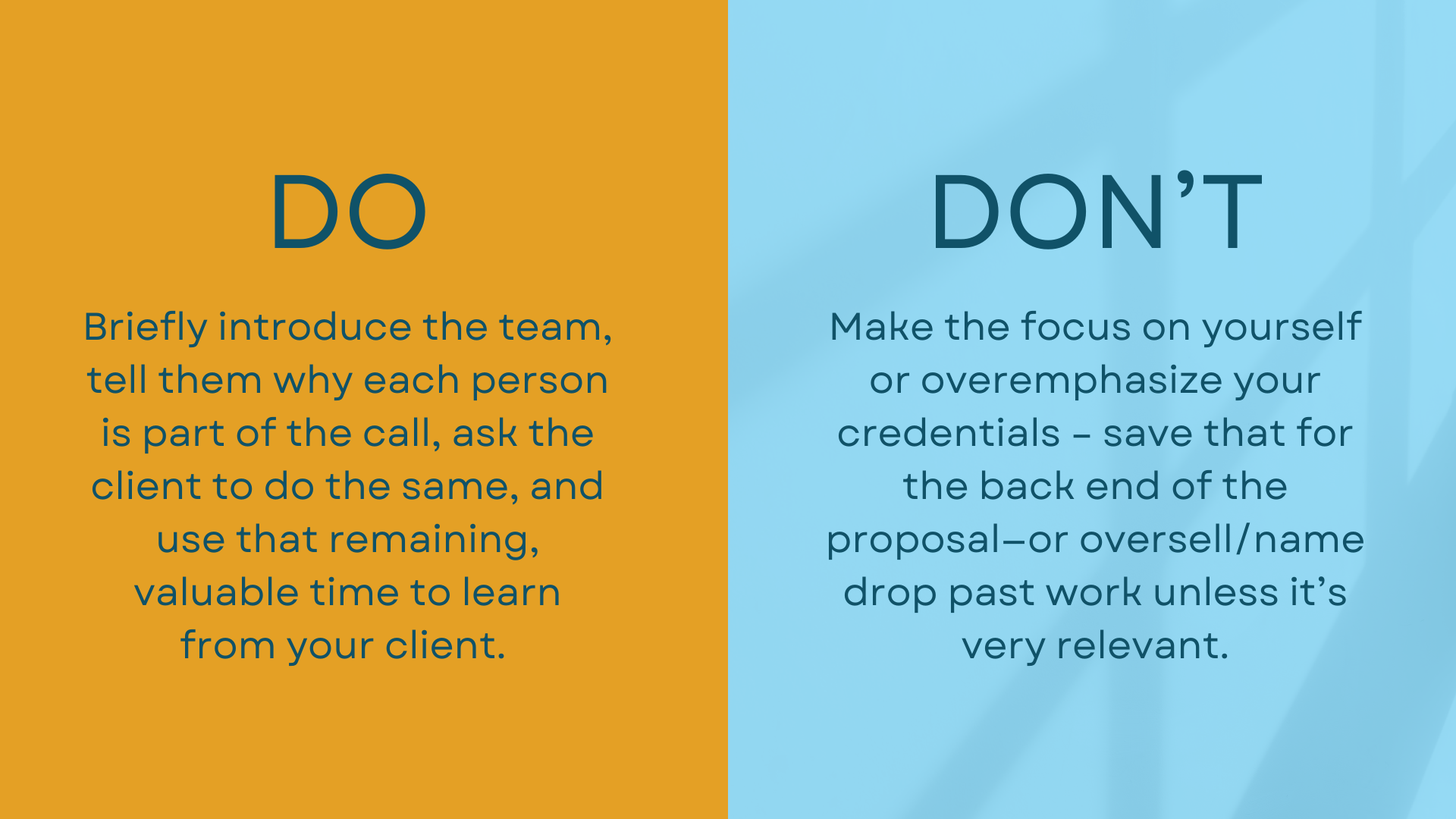
Setting a Foundation
The discovery call should establish trust between the client and the agency and provide the basis for a two-way relationship to form. The conversational tone of the call should facilitate two important building blocks:
Through an interactive, Q&A style dialogue, the consultant develops an understanding of the client’s research need so we address their expressed challenges.
Because we listen first and ask probing questions, it leaves room for a more proactive posture and potentially opens the door to a more efficient or robust solution.
Listening for What’s NOT Said
Absorbing the preliminary information shared and asking critical follow up questions is the only way to uncover the REAL need. Direct clients are sometimes asked to scope studies by management, who may be focused on the symptom of a business challenge/research issue rather than the cause. Using our interactive, “Q&A style” discovery approach may sometimes reveal deeper issues, related issues or a more efficient research pathway that can more completely help the client’s business than what they already know/have, what their stated objective is and what they’d like to have (or options to consider) as a solution.

Creating a Roadmap: Critical Content to Discover
Every discovery call, like every project, is going to be different. But, there are content elements that do need to be brought into each and every discovery call.
Here are some key questions to be asked:
- What business challenge is driving the need?
- If you were doing the research yourself, “what don’t you know?
- Who will use the research internally ?
- What, if anything, has been done in the past?
- Why are you conducting the research now?
- Timing?
- Budgetary parameters to be aware of?
- Key characteristics of the respondent audience (to determine feasibility/ approach)?
- Where is the sample coming from?
Of course, it is also imperative to ask specific question about the project at hand – do get granular if they are looking for a proposal as a next step, or won’t have time for an additional call.
After the Call
It is good practice to send a consolidated version of the notes you took to your client. The notes simply capture what you heard (“you said this was important”) and demonstrate how thoroughly you listened to them during the call. Notes also allow (re: trigger) the client to clarify, reiterate or refine their thought process when they see the overview of the conversation.
In summary, discovery calls are not only extremely valuable but should be very enlightening. The discovery call is necessary to create an informed path forward. A client wants to discuss their research in detail because it’s the only way they can be assured of a winning outcome.